‘It looked as if we had seen the devil’
james mennie
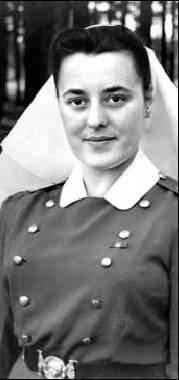
COURTESY OF GAETANE KERR Lt.-Nursing Sister Gaëtane Labonté saw the hell of D-Day in the aftermath.
“I
have a lot of nicer pictures. But that one means a lot to me.”
She’s 25 years old in the
photograph, a nursing sister all starched and pressed and polished
in her Royal Canadian Army Medical Corps uniform. And it isn’t
until you look at her eyes that you realize this is the picture
she had talked about, the one taken just a few days after D-Day,
just after Gaëtane Kerr had spent two days staring into hell.
Yesterday, while Canada remembered its
war dead, Kerr, 85, picked up the phone and engaged in a ritual
she has observed for nearly six decades.
She
remembered with the living.
“I
made calls to two members of my unit in Montreal, and tonight I’ll
call another in Cape Breton. After 6, I’ll save money,”
she said yesterday from her home in St. Donat.
“We
used to keep in touch all the time. It’s more difficult now,
but it’s important, especially at this time of year.”
When I first spoke to Kerr last May, I
thought I already had what I needed to tell the story of what had
happened to Canadians on D-Day.
There
was the paratrooper who was among the first to land in France and
the gunner on the RCAF bomber whose mission helped blast a way for
that paratrooper to get in. I had the seamen on the minesweepers
and the destroyers that protected the invasion fleet and I had the
infantryman who, at age 19, had his baptism of fire scrambling up
Juno Beach between the bodies of his comrades.
But
in observing the 60th anniversary of June 6, 1944, it seemed
appropriate to look at D-Day plus 1, to speak to those who had
sewn up the wounded, held them still as their shattered limbs were
removed, seen the cost of victory scream and bleed on the
stretchers they pulled off the trucks on June 7.
And
that’s when I first heard about the photograph.
Kerr
enlisted as a nursing sister in 1942 and spent two years
performing regular nursing duties before D-Day unleashed the
realities of war on her and those in her unit. In the days after
the invasion, Kerr worked nearly non-stop, tending to the flood of
wounded – Allied and German – pulled off the beaches
of Normandy.
Once things had calmed
down, someone decided to photograph the Canadian nurses who had
worked that bloody shift. Kerr said that when she showed the
picture around afterward, people couldn’t help but notice
the eyes of the primly dressed women of the RCAMC: “It
looked as if we’d seen the devil.”
This
week, I learned what Kerr had meant. She had mailed me the
photograph along with a letter thanking me for the story I’d
written. She hadn’t been able to find the photo when we had
spoken earlier this year and she apologized for not having sent it
sooner, but her husband (whom she met while serving in Belgium and
Holland after D-Day) had passed away this year.
She
had signed the letter Lieutenant/Nursing Sister Labonté,
the rank and name she had when she served her country.
Kerr
told me about the day’s phone calls and, even though it’s
been more than half a century, she reminded me that as important
as our duty is to the dead, hers was – and is – to the
living.
“People don’t know
that we were so close to the patients,” she said. “If
I were a brigadier, I’d give medals to the patients in the
hospitals.”
And that’s
when you realize that while we tend to look to the past every Nov.
11, Kerr’s story doesn’t end in 1945. I’m going
send to the photgraph back to her, but I’ll keep a copy, and
right alongside I’m going to keep a photograph shot this
week in the streets of Baghdad.
There
are six of them, U.S. army medics rolling a stretcher carrying an
infantryman whose chest has been blown open during the fighting in
Fallujah.
They’re not starched
or pressed or polished, and they seem a world and an age away from
Gaëtane Kerr.
Until you look a
little more closely.
Until you look at
their eyes.
jmennie@
thegazette.canwest.com
